
Passing an SAP certification takes more than a folder of study files and memorized configuration steps. You need product knowledge and the kind of reasoning used on real implementation projects. For people working with SAP SuccessFactors Onboarding, C_THR97_2605 is a useful reference for building both.
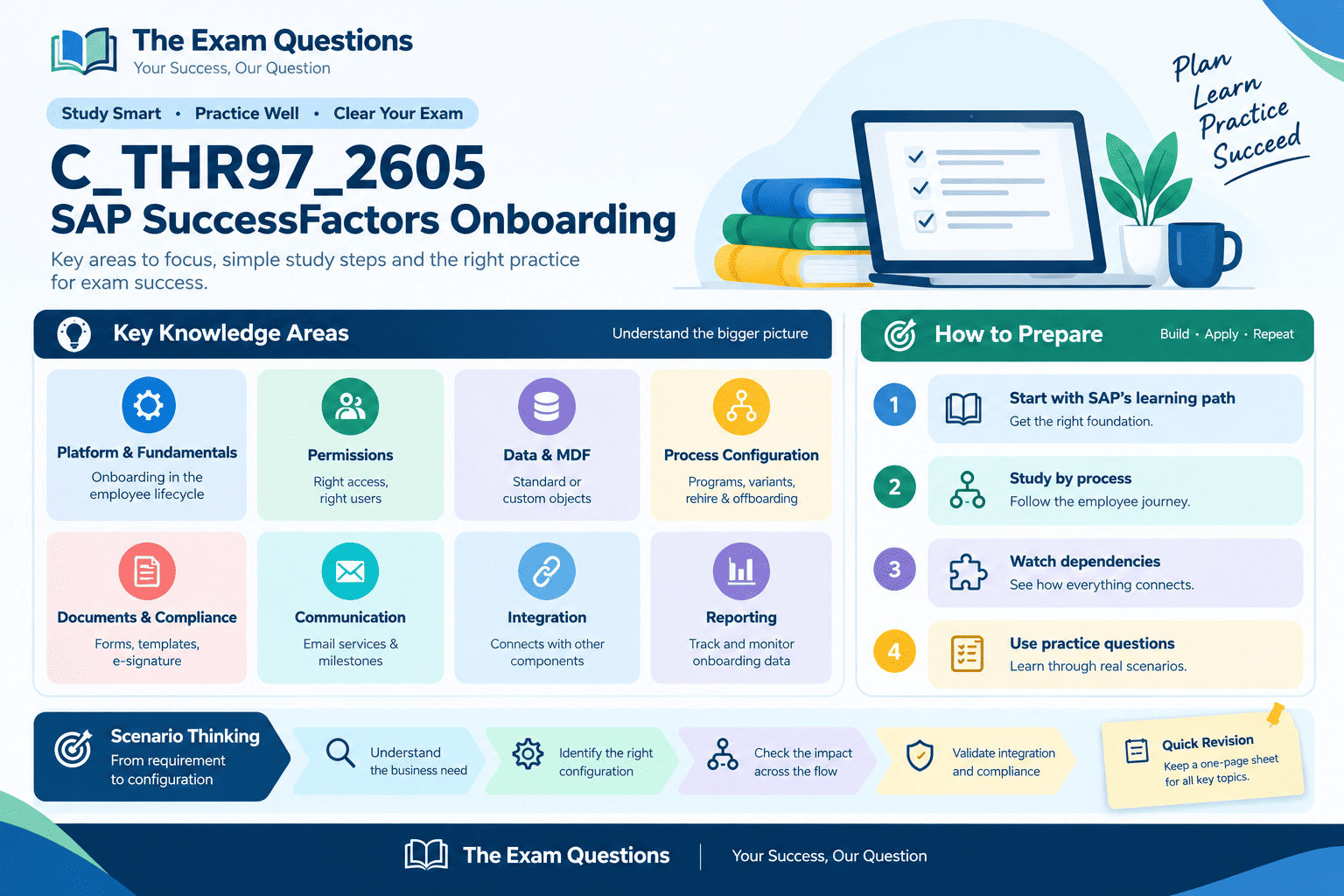
The learning path for SAP SuccessFactors Onboarding covers configuring core functionality, working with onboarding data, managing permissions, handling documents and compliance, and understanding integrations. SAP lists Configuring SAP SuccessFactors Employee Central Core as a prerequisite and names the Onboarding Academy as the central learning resource for consultants.
This guide covers how to study these areas, how scenario-based practice helps, and how to use free practice questions as one part of your plan.
Understanding C_THR97_2605 and SAP SuccessFactors Onboarding
SAP SuccessFactors Onboarding supports the processes around new hires and related employee lifecycle activities. A consultant has to understand how data, permissions, workflows, documents, and integrations fit together across the individual screens.
SAP's current material covers role-based permissions, onboarding data models, programs, compliance forms, custom MDF objects, document templates, e-signature tools, email services, rehire processes, process variants, internal hires, offboarding, integrations, and reporting. Practical knowledge grows from the connections between these topics, so the full scope matters for C_THR97_2605.
Core knowledge areas to study
- Platform and onboarding fundamentals: the overall SuccessFactors environment and where Onboarding sits in the employee lifecycle.
- Role-based permissions: how access is granted and how permissions affect different users and processes.
- Data modeling: the onboarding data model, and when standard objects or custom MDF objects are appropriate.
- Process configuration: programs, process variants, onboarding activities, rehire scenarios, internal hires, and offboarding.
- Documents and compliance: compliance forms, document templates, electronic signatures, and information collection.
- Communication: how email services support onboarding milestones and user communication.
- Integration: how Onboarding connects with other SuccessFactors components and why data flow matters.
- Reporting: a basic understanding of how onboarding information is monitored and reported.
SAP's Onboarding Academy currently has 20 learning units. They cover these areas, and the final unit is about succeeding as a consultant.
How to prepare for C_THR97_2605
Many candidates treat every topic as a separate set of facts. Configuration is easier to remember when you know the business reason behind each setting. When you meet a permission name, ask who should see the information, at what stage, and what happens if the wrong user gets it. That habit builds implementation judgment.
1. Start with SAP's learning path
The learning journey Configuring SAP SuccessFactors Onboarding is the logical starting point. It expects Employee Central Core knowledge and connects to the Onboarding Academy. Starting there also fixes the terminology before you read third-party summaries or practice questions.
2. Study by process
Draw a simple map that follows the employee. A new hire is initiated, data is collected, tasks are completed, documents are generated and signed, compliance information is handled, the record integrates with Employee Central, and onboarding completes. Then attach each configuration setting to the stage where it applies. This gives you a mental model that lasts longer than a list of menu paths.
3. Watch configuration dependencies
Scenario questions get easier once you see the dependencies. Say a business wants extra information from one group of new hires. Several questions arrive at once:
- Where should the information be stored, and which object or data structure fits?
- Which users need access?
- When should the information be collected?
- Which rule or process configuration controls the behavior?
- Does any downstream integration depend on the data?
Working through these relationships turns theory into practical knowledge.
4. Use practice questions to learn
The free resource at The Exam Questions has sample scenario-based questions with explanations for SAP SuccessFactors Onboarding. Its examples touch on Role-Based Permissions and MDF-related configuration. The value is in the reasoning behind each answer. After every question, ask why the configuration works, why the other options fit less well, and what business requirement the scenario describes.
Building scenario-based thinking for C_THR97_2605
Real consulting work rarely states a requirement as a definition. A business stakeholder describes a problem in operational language, and your task is to translate it into system configuration.
Suppose a company wants different onboarding activities for two employee populations. A workable sequence:
- Identify the business difference.
- Find the onboarding process or configuration that controls it.
- Decide whether a rule, program, process variant, permission, or data object is involved.
- Consider how the change affects the rest of the onboarding flow.
- Check whether an integration or compliance requirement depends on it.
This builds understanding where recall alone would not.
Make a personal revision sheet
A one-page sheet works well. Give it a section each for permissions, data model, process, documents, compliance, email, rehire, offboarding, integrations, and reporting. Under each, note the feature's purpose, its main configuration concept, its dependencies, and one practical example. In the last days before the exam, that page is your compact revision framework.
How free practice resources fit into your study plan
Free resources lower the cost of early preparation and give you more chances to test yourself. The Exam Questions page offers free C_THR97_2605 scenario-based practice questions with detailed explanations. They work best as a supplement to SAP's own training.
Foundation stage
Begin with SAP's learning journey for the official SAP certification and get clear on the SuccessFactors platform and the Onboarding architecture.
Application stage
Work through configuration examples and tie each topic to a business scenario.
Practice stage
Use free sample questions to find gaps. Record each question you miss and note why: terminology, configuration logic, permissions, data modeling, process flow, or integration.
Review stage
Go back to SAP's material for every weak area. This closes the gap between recognizing a question and understanding the answer, and repeatedly linking theory to application helps you retain it.
Common preparation mistakes
Relying on memorization
Remembering terms helps with revision, but implementation knowledge needs context. Tie each configuration feature to its purpose.
Ignoring permissions and data modeling
These subjects shape how information moves through the solution and how users interact with it. The Onboarding Academy gives each its own learning unit.
Studying one topic at a time
Onboarding topics overlap. A question about documents can involve permissions, data collection, workflow, and communication at once.
Treating third-party material as the authority
Third-party practice resources are good for rehearsal. SAP's own content should stay your main reference for product knowledge.
Skipping review after practice
A wrong answer points to a gap. Spend more time on the explanation than on checking whether you picked the right option.
Why practical understanding matters after the exam
Preparing for the exam builds skills you use on real SuccessFactors projects. Knowing data structures, permissions, onboarding workflows, integrations, and document processes makes conversations with HR stakeholders and technical teams clearer. The Academy's consultant unit ties the product study to consulting work.
Frequently asked questions
What is C_THR97_2605?
C_THR97_2605 is the SuccessFactors Onboarding certification preparation resource listed on The Exam Questions website. The underlying SAP learning path covers configuring core Onboarding functionality and related implementation skills.
What should I study for C_THR97_2605?
Follow the areas in SAP's Onboarding Academy: role-based permissions, data modeling, onboarding programs, compliance forms, MDF objects, documents and e-signature, email services, rehire, offboarding, integrations, and reporting.
Are free C_THR97_2605 practice questions useful?
Yes. They help you test recall, find weak areas, and get used to scenario-style thinking. They work best alongside SAP's own material. The Exam Questions currently offers free scenario-based examples with explanations.
Should I memorize configuration steps?
Memorization has a place in revision, but the purpose of a configuration choice matters more. Build your preparation around business requirements, dependencies, process flow, permissions, and data movement.
Where should I begin?
Start with SAP's Configuring SAP SuccessFactors Onboarding learning journey, then work through the Onboarding Academy and use practice questions to reinforce what you have studied. SAP lists Employee Central Core knowledge as a prerequisite.
Conclusion
Preparation for C_THR97_2605 works best when it combines SAP's own training, practical configuration knowledge, structured revision, and scenario-based practice. The aim is to understand how onboarding requirements become system decisions. Start with SAP's learning journey, then test yourself with free practice questions from The Exam Questions.